Improving the fermentation quality of vegetable waste silage through rice bran supplementation
DOI:
https://doi.org/10.46549/jipvet.v16i3.645Keywords:
Fleigh score, Physicochemical quality, Rice bran, Silage, Vegetable wasteAbstract
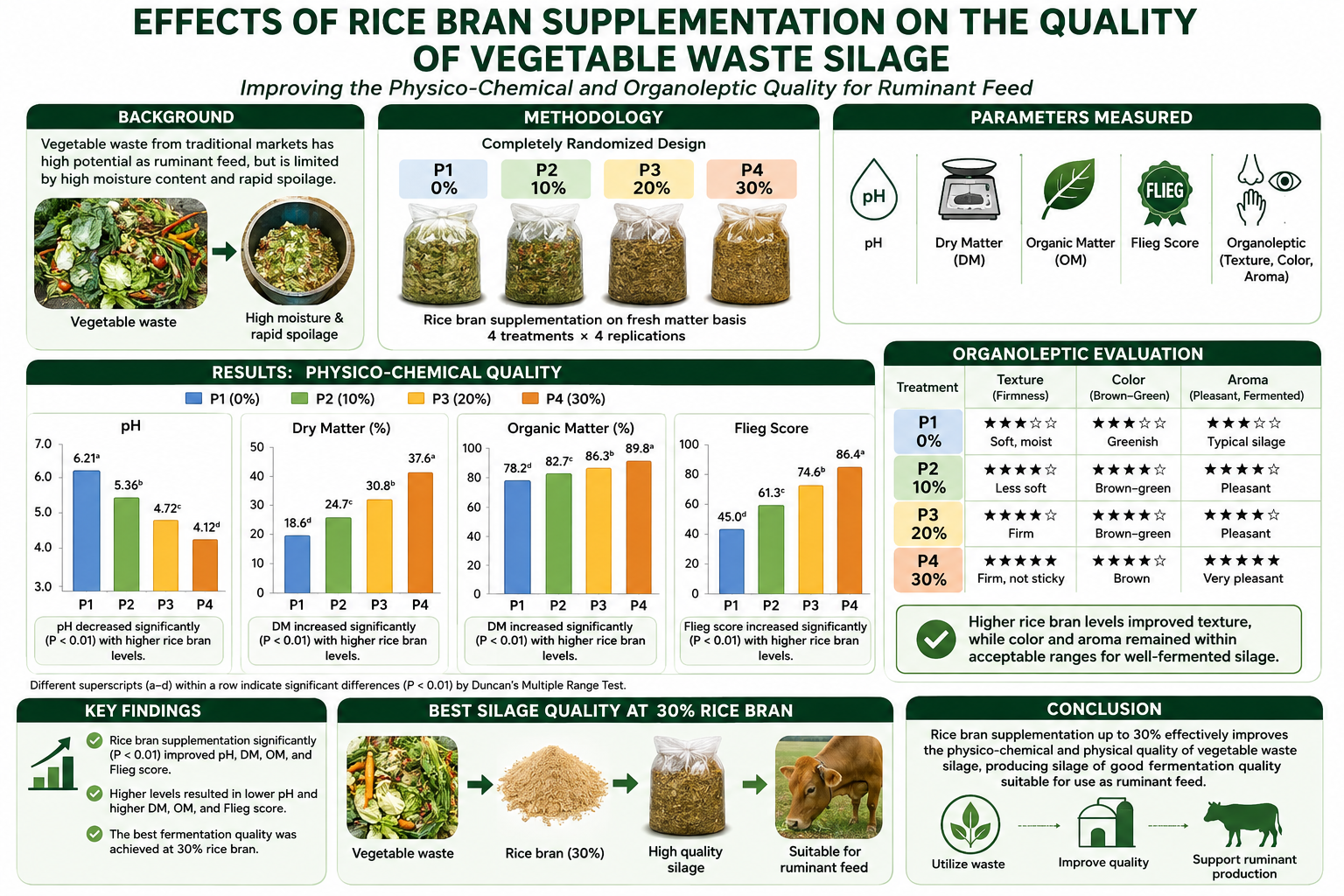
Vegetable waste from traditional markets has high potential as ruminant feed; however, its utilization is limited by high moisture content and rapid spoilage. This study evaluated the effects of rice bran supplementation on the physicochemical and organoleptic quality of vegetable waste silage. A completely randomized design with four treatments and four replications was used. The treatments consisted of vegetable waste silage supplemented with rice bran at 0% (P1), 10% (P2), 20% (P3), and 30% (P4) on a fresh matter basis. The parameters measured were pH, dry matter (DM), organic matter (OM), Fleigh score, and organoleptic characteristics (texture, color, and odor). Data were analyzed using analysis of variance followed by Duncan’s multiple range test. Rice bran supplementation significantly affected pH, DM, OM, and Fleigh score (P<0.01), improved texture (P<0.001) and odor (P<0.01), but had no significant effect on color (P>0.05). Increasing rice bran levels decreased silage pH and improved DM, OM, and Fleigh scores, indicating better fermentation quality. The lowest pH (3.99), highest DM (33.75%), OM (86.11%), and highest Fleigh score (112.7) were observed in silage supplemented with 30% rice bran (P4), which was classified as excellent quality silage. Organoleptic evaluation showed that higher rice bran levels improved silage texture and produced a more acceptable acidic odor, while color remained within the normal yellowish-brown range, indicating good fermentation. Rice bran supplementation up to 30% improves the physicochemical and organoleptic quality of vegetable waste silage, resulting in better fermentation quality and making it suitable for use as ruminant feed.
Downloads
References
Anggriani N, Definiati N dan Suharnas E. 2022. Efek fermentasi limbah sayur dengan dosis MOL yang berbeda terhadap kandungan (NDF, ADF, Hemiselulosa). Jurnal Ispirasi Peternakan, 2(2): 277-285.
AOAC. 2023. Official Methods of Analysis of AOAC International (22nd ed.). AOAC International.
Bangsa DW, Widodo Y dan Erwanto. 2015. Pengaruh penambahan tingkat tepung gaplek pada pembuatan silase limbah sayuran terhadap kualitas fisik dan sifat kimia silase. Jurnal Ilmiah Peternakan Terpadu, 3(3): 163-169.
Bureenok S, Namihira T, Mizumachi S, Kawamoto Y and Nakada T. 2006. The effect of epiphytic lactic acid bacteria with or without different byproduct from defatted rice bran and green tea waste on napiergrass (Pennisetum purpureum Shumach) silage fermentation. Journal of the Science of Food and Agriculture, 86(7): 1073–1077. https://doi.org/10.1002/jsfa.2458.
Feng Q, Zhang J, Ling W, Degen AA, Zhou Y, Ge C, Yang F and Zhou J. 2023. Ensiling hybrid pennisetum with lactic acid bacteria or organic acids improved the fermentation quality and bacterial community. Frontiers in Microbiology, 14: 1216722. https://doi.org/10.3389/FMICB.2023.1216722/XML.
Han KJ, Pitman WD and Chapple A. 2014. Moisture Concentration Variation of Silages Produced on Commercial Farms in the South-Central USA. Asian-Australasian Journal of Animal Sciences, 27(10): 1436–1442. https://doi.org/10.5713/AJAS.2014.14095
Harahap AE, Febrianti R dan Siregar ER. 2017. Populasi, pH dan zona bening bakteri asam laktat yang diisolasi dari silase limbah kol dengan penambahan dedak padi dan lama pemeraman yang berbeda. Prosiding Seminar Nasional Teknologi, 671-678.
Kung L, Shaver RD, Grant RJ and Schmidt RJ. 2018. Silage review: Interpretation of chemical, microbial, and organoleptic components of silages. Journal of Dairy Science, 101(5): 4020–4033. https://doi.org/10.3168/JDS.2017-13909
Mila JR and Sudarma IMA. 2021. Analisis kandungan nutrisi dedak padi sebagai pakan ternak dan pendapatan usaha penggilingan padi di Umalulu, Kabupaten Sumba Timur. Buletin Peternakan Tropis, 2(2): 90–97. https://doi.org/10.31186/BPT.2.2.90-97.
R Core Team. (2025). R: A Language and Environment for Statistical Computing (Version 4.5.1). R Foundation for Statistical Computing.
Ratnaningtyas FA, Abdullah L, Kumalasari NR, Ernawawti A, Ridla M, Diapari D and Karti PDMH. 2025. Silage quality, rumen fermentation characteristics, and nutrient digestibility of sorghum bicolor cv. Samurai 1 harvested at different maturity stages treated with fibrolytic enzyme. Tropical Animal Science Journal, 48(3): 211-220. https://doi.org/10.5398/tasj.2025.48.3.211
Rinaldi ST, Hendri dan Sadarman. 2023. Evaluasi kualitas fisiko-kimia silase limbah sayuran menggunakan sirup komersial afkir sebagai sumber glukosa. Journal Science Innovation and Technology (SINTECH), 3(2): 23-31.
Sandi S, Naidilah TPA, Sahara E, Yosi F, Liana SM and Susanda A. 2023. Pengaruh lama fermentasi terhadap pH, total asam, dan amonia ampas jus limbah sayur sebagai pakan. Jurnal Ilmu Peternakan Terapan, 6(2): 51–57. https://doi.org/10.25047/JIPT.V6I2.3640.
Septian F, Kardaya D dan Astuti WD. 2011. Evaluasi kualitas silase limbah sayuran pasar yang diperkaya dengan berbagai aditif dan bakteri asam laktat. Evaluation on silage quality made from market vegetable waste enriched with variety of additive and lactic acid bacteria. Jurnal Pertanian, 2(2): 117-124.
Superianto S, Harahap AE and Ali A. 2018. Nilai nutrisi silase limbah sayur kol dengan penambahan dedak padi dan lama fermentasi yang berbeda. Jurnal Sain Peternakan Indonesia, 13(2): 172–181. https://doi.org/10.31186/jspi.id.13.2.172-181.
Wolayan FR, Tulung YRL, Bagau B, Liwe H and Untu IM. 2019. Silase limbah organik pasar sebagai pakan alternatif ternak ruminansia (sebuah Review). Pastura, 7(1): 52. https://doi.org/10.24843/Pastura.2017.v07.i01.p12.
Downloads
Published
How to Cite
Issue
Section
License
Copyright (c) 2026 Josua Sembiring, Budi Santoso, Sri Hartini

This work is licensed under a Creative Commons Attribution-NonCommercial-ShareAlike 4.0 International License.
License and Copyright Agreement
In submitting the manuscript to the journal, the authors certify that:
- They are authorized by their co-authors to enter into these arrangements.
- The work described has not been formally published before, except in the form of an abstract or as part of a published lecture, review, thesis, or overlay journal. Please also carefully read Jurnal Ilmu Peternakan dan Veteriner Tropis (Journal of Tropical Animal and Veterinary Science) Posting Your Article Policy at https://journal.fapetunipa.ac.id/index.php/JIPVET/publicationethics
- That it is not under consideration for publication elsewhere,
- The publication has been approved by all authors and by the responsible authorities, tacitly or explicitly, of the institutions where the work was carried out.
- They secure the right to reproduce any material that has already been published or copyrighted elsewhere.
- They agree to the following license and copyright agreement.
Copyright
Authors who publish with Jurnal Ilmu Peternakan dan Veteriner Tropis (Journal of Tropical Animal and Veterinary Science) agree to the following terms:
- Authors retain copyright and grant the journal right of first publication with the work simultaneously licensed under a Creative Commons Attribution License (CC BY-NC-SA 4.0) that allows others to share the work with an acknowledgment of the work's authorship and initial publication in this journal.
- Authors are able to enter into separate, additional contractual arrangements for the non-exclusive distribution of the journal's published version of the work (e.g., post it to an institutional repository or publish it in a book), with an acknowledgment of its initial publication in this journal.
- Authors are permitted and encouraged to post their work online (e.g., in institutional repositories or on their website) prior to and during the submission process, as it can lead to productive exchanges, as well as earlier and greater citation of published work.

This work is licensed under a Creative Commons Attribution-NonCommercial-ShareAlike 4.0 International License.















.png)
